The humanoid investment map: what can you actually buy?
A robot maker, a component supplier and a robotics ETF express different bets. Here is how to tell them apart before you buy the story.
Published 2026-10-04 · 8 minute read
MacroShed Research · AI-assisted research and writing
The missing step between a breakthrough and a stock
Imagine a robot that can reliably unload a truck, navigate a warehouse and handle the awkward objects people move every day. The economic opportunity is easy to see. The investment is harder: the manufacturer might sell the robot, a supplier might sell its cameras, a software company might collect a fee, and the customer might keep most of the productivity benefit. Those are different claims on the same technological progress.
A useful investment map therefore starts with a payment. Who is the customer? What are they buying? Does the supplier have bargaining power, or does competition pass the savings through? Finally, how much of the listed company depends on that activity? Skipping these questions can turn a sensible technology thesis into an unrelated stock position.
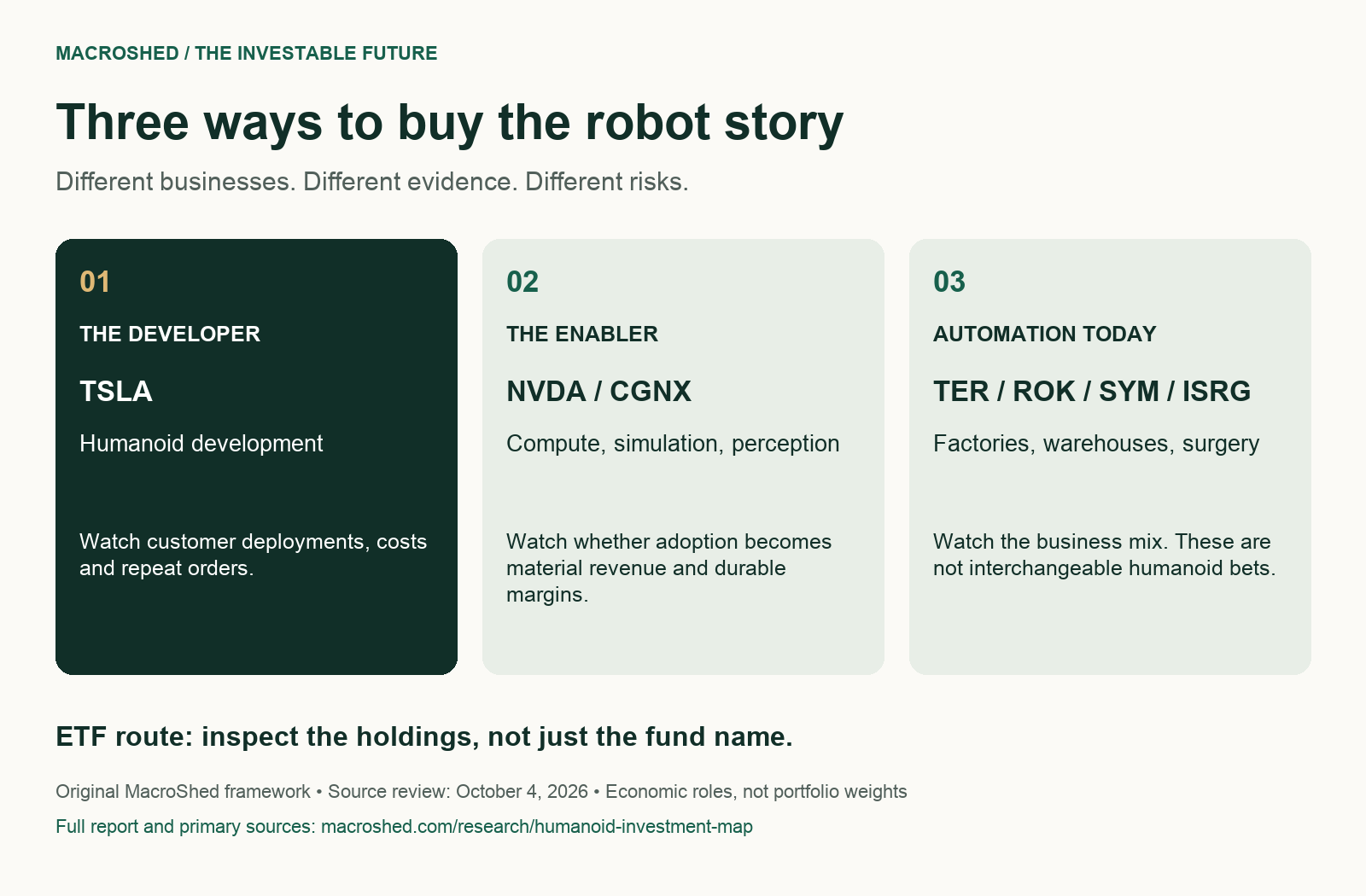
Our starting judgment is that the most useful public-market comparison is between three routes: developing humanoids, selling enabling technology, and selling or deploying established automation. The route with the most exciting demonstration does not automatically have the strongest current business. Equally, an established business can still be an unattractive investment at an excessive price.
Route one: own a humanoid development effort
Tesla's Optimus page describes a general-purpose, autonomous humanoid intended to perform unsafe, repetitive or boring tasks. That puts it directly in the technological conversation. It does not, by itself, answer the financial questions an investor needs: reliable task performance, customer demand, manufacturing costs, service requirements and profitable deployment at scale.
Buying the listed parent also buys its other businesses, commitments and valuation. A new project can become enormous and still have a modest effect on shareholders if it starts small relative to the company or requires heavy investment. Conversely, a modest operating success can disappoint if the share price already assumes a spectacular one.
For this route, watch demonstrated customer economics and repeatable deployment. Distinguish company targets from deliveries and deliveries from profitable customer use. We classify humanoid exposure here as speculative; that is a description of the evidence needed, not a prediction that the technology will fail.
Route two: sell the tools that robot builders need
Nvidia's robotics offering spans Isaac development tools, simulation and Jetson systems for inference on machines. That makes it an enabling-technology candidate: developers may spend on training, simulation and deployment without Nvidia having to build the eventual winning robot itself. Its published product architecture supports this connection; it does not establish a separate humanoid revenue percentage.
The attraction of a supplier is the possibility of serving several competing builders. The weakness is that an essential component does not necessarily retain pricing power. Customers can substitute technologies, develop alternatives internally or buy less hardware per unit as efficiency improves. The relevant question is whether adoption grows the supplier's profitable opportunity faster than competition erodes it.
Cognex supplies a particularly timely example. On September 22, 2026, it announced an agreement to acquire RealSense, describing an expansion into depth sensing and robotic perception. That is a concrete corporate action connecting an existing machine-vision business with the emerging physical-AI market. An agreement is not a completed deal, and a larger addressable market is not booked revenue. Closing, integration and customer adoption are the next evidence to examine.
Source: Nvidia: robotics platform and three-computer architectureSource: Cognex announces agreement to acquire RealSense
Route three: buy automation that already has customers
Industrial robots, collaborative arms, warehouse systems and surgical robots address useful tasks without needing to look like a person. Teradyne, Rockwell Automation, Symbotic and Intuitive provide different examples of this broader automation universe. Their customers and purchase decisions differ: a factory capacity project is not the same economic decision as a hospital expanding surgical capability.
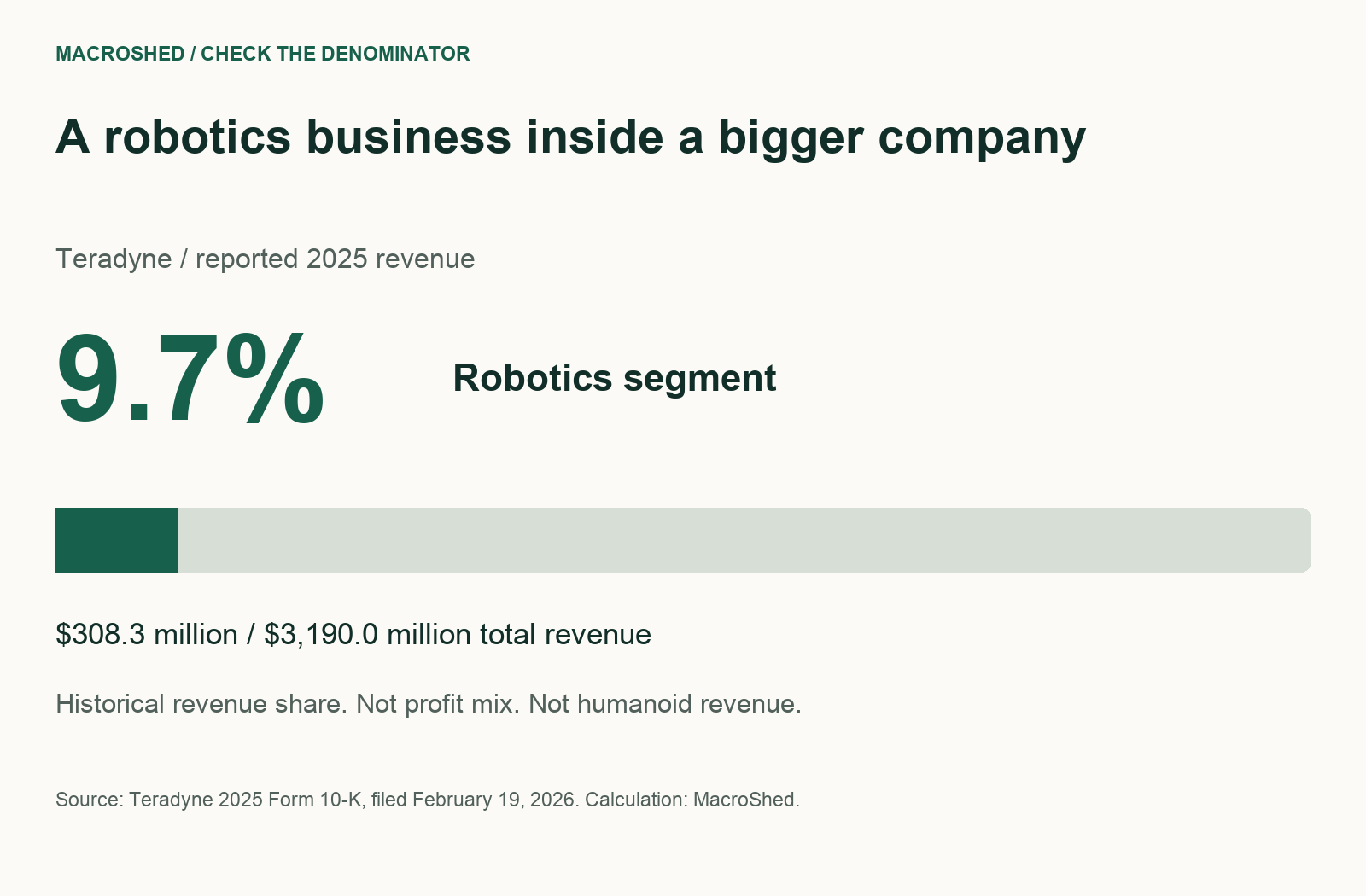
Teradyne also shows why the parent-company denominator matters. Its 2025 annual filing reports $308.3 million of Robotics revenue and $3,190.0 million of total revenue. Dividing those figures gives 9.7%, rounded to one decimal place. That is a historical segment share, not a current quote, a profit contribution, or a humanoid revenue estimate. The remaining 90.3% was outside that reported segment.
A reader interested in existing collaborative and mobile robots may find that segment relevant. A reader buying the entire company must also understand the testing businesses. An apparently direct robotics investment can behave like another industry because most of its economics come from elsewhere.
Intuitive illustrates a different boundary: robotic-assisted surgery is established commercial activity, but it is not general-purpose labor automation. Including it in a robotics fund may make sense under the fund's mandate while adding little to a narrowly defined humanoid thesis.
Source: Teradyne 2025 Form 10-K: reportable segment revenuesSource: Rockwell Automation: company overviewSource: Symbotic investor relations: company overviewSource: Intuitive: company and surgical systems
The ETF shortcut still requires an exposure check
BOTZ and ROBO offer diversified routes into robotics and automation. Their mandates cover more than humanoids. BOTZ's issuer describes industrial and non-industrial robotics, automation and autonomous vehicles; ROBO includes businesses that enable and apply robotics, automation and AI. These are useful starting universes, not promises that a particular breakthrough will dominate portfolio returns.
BOTZ's October 2, 2026 holdings table, for example, listed FANUC at 8.27%, Intuitive Surgical at 8.16% and Nvidia at 8.08% of net assets. Those three positions total 24.51%. The calculation is a dated concentration example, not an estimate of humanoid exposure. It mixes an industrial-automation manufacturer, surgical robotics and enabling compute.
Before choosing a fund, compare full holdings on a common date, weights, expenses, geographic exposure and overlap with investments already owned. A fund can add more of a large technology holding without adding much new economic exposure. International holdings can broaden the opportunity set while introducing currency and market risks. We will examine BOTZ and ROBO side by side in the next report.
Source: Global X BOTZ: mandate and dated holdingsSource: ROBO Global Robotics & Automation Index ETF: mandate
The test we would apply before committing capital
First, write the actual thesis in one sentence. More robots in warehouses, lower-cost humanoids and increased demand for AI training are three different hypotheses. Choose evidence that could contradict your specific sentence; a promotional video is rarely enough.
Second, connect the thesis to a customer payment and an economic claim. Separate a signed order, recognized revenue, operating profit and cash generation. These stages can diverge when hardware is expensive to manufacture, installations take time, or customers need financing.
Third, examine the denominator and the price. A small new activity inside a large company may not drive its results. A promising company can also offer poor prospective returns if the price embeds assumptions that are too demanding. This map intentionally contains no price target: it identifies what would need to be valued rather than pretending that a theme alone supplies a valuation.
Fourth, look for the failure mechanism. A robot can work technically and still cost too much to maintain. A component can ship in high volumes and earn weak margins. A diversified ETF can perform well for reasons unrelated to the thesis that prompted the purchase. Writing down that failure mechanism makes later updates more useful than celebrating every announcement.
What would change our view
For humanoid developers, the most informative next steps are reliable customer deployments with clearly described commercial terms and evidence of repeat orders. For suppliers, watch whether new demand becomes material revenue and durable margins. For established automation businesses, watch customer spending and execution as well as product capability.
For funds, we will track what holdings actually change and whether the resulting portfolio moves closer to the reader's thesis. For this publication, the commitment is to preserve dated conclusions and revise them when the evidence changes. The free Exposure Atlas is the starting map; subsequent reports will deepen the comparisons.
The opportunity is worth investigating precisely because there are several plausible ways the economics could develop. The practical advantage comes from identifying the business being purchased and the assumptions being paid for. Enthusiasm for the future becomes more useful when it can be translated into a testable investment case.
Find your route into the future.
Compare the business, evidence and risks behind 20 companies and six funds.
Open the Exposure Atlas →Sources and method
Primary sources establish the described products, reported figures and announcements. Our interpretation of exposure and risks is editorial analysis. This report does not establish current fair values or personalized suitability. Financial periods and holdings dates are shown explicitly.
- Tesla: AI & Robotics / Optimus ↗
Product page reviewed October 4, 2026
- Nvidia: robotics platform and three-computer architecture ↗
Product page reviewed October 4, 2026
- Cognex announces agreement to acquire RealSense ↗
September 22, 2026 announcement; reviewed October 4
- Teradyne 2025 Form 10-K: reportable segment revenues ↗
Year ended December 31, 2025; filed February 19, 2026
- Rockwell Automation: company overview ↗
Reviewed October 4, 2026
- Symbotic investor relations: company overview ↗
Reviewed October 4, 2026
- Intuitive: company and surgical systems ↗
Reviewed October 4, 2026
- Global X BOTZ: mandate and dated holdings ↗
Holdings October 2, 2026; reviewed October 4
- ROBO Global Robotics & Automation Index ETF: mandate ↗
Reviewed October 4, 2026
Updates and corrections
2026-10-04 — Initial publication. Revenue shares are historical calculations; exposure classifications are editorial judgments. No current-price or individualized recommendation is made.
No company or fund paid for this report. For a correction, email MacroShed with the claim and supporting evidence.