Does printing multiple copies save filament on a Bambu AMS?
A one-cube plate uses 104 g. A nine-cube plate uses 195 g. Here’s how to find the batch size worth printing for your own model.
Published 2026-11-27 · 3 minute read
MacroShed
One cube versus a full plate
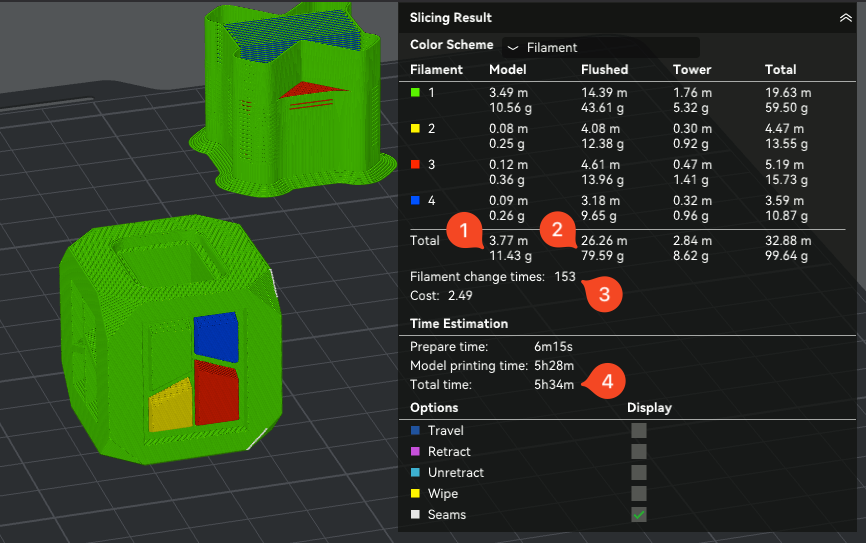
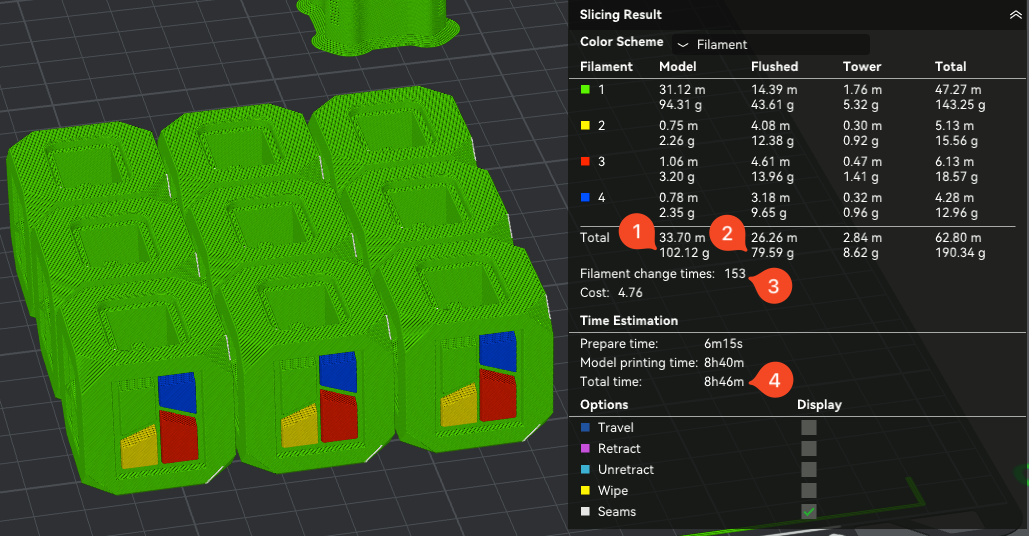
Nine four-color cubes together use less filament than two of the same cube printed on separate plates. You can check the arithmetic in two Bambu Studio screenshots. The single cube takes 104.42 g. Two single-cube runs take 208.84 g. All nine together take 195.11 g. The nine-cube plate also finishes 2 hours and 22 minutes ahead of the two separate runs, according to the slicer.
One cube: 11.43 g in the model, 79.59 g flushed and 13.40 g in the prime tower. Total, 104.42 g. The slicer predicts 153 filament changes and 5 h 34 min.
Nine cubes: 102.12 g in the models, 79.59 g flushed and 13.40 g in the prime tower. Total, 195.11 g. The slicer predicts 153 filament changes and 8 h 46 min.
The printer can lay down a given color on all nine copies before changing filament. On these two plates, eight extra cubes add 90.69 g of material and zero extra color changes. Rotate one cube so its colors appear at different heights and the pattern changes. In SparkLab’s example, rotating one of the nine raised the count to 284 changes.
Source: Bambu Studio slice of one four-color cubeSource: Bambu Studio slice of nine four-color cubesSource: University of Northern British Columbia SparkLab, multicolor AMS printing
How many copies should you print?
Slice the quantities you could actually use. Start with one copy, the number already promised, and a full plate. Keep the orientation, layer height, color settings and print sequence fixed. Write down the slicer’s Total grams and machine time for each. For three known orders, compare one three-copy plate, three single runs and any larger batch you're considering. The smallest total that fills the orders wins on material. Use the total-time column to see what each choice does to the queue.
For a speculative batch, divide the full plate’s total grams by the single plate’s total grams. In this example, 195.11 ÷ 104.42 = 1.87. Against printing each order separately, you need an average of more than 1.87 useful copies per nine-cube batch for batching to save material.
Say one order is definite, there could be one more, and you can always print the second one later. Filling the plate today costs an extra 90.69 g for certain. Waiting costs an extra 104.42 g only if that second order arrives. The full plate breaks even at an 87% chance of a second order. A two-copy plate is a third option. Slice it before making nine for two customers.
Source: Bambu Studio slice of one four-color cubeSource: Bambu Studio slice of nine four-color cubes
Find your route into the future.
Compare the business, evidence and risks behind 20 companies and six funds.
Open the Exposure Atlas →Sources and method
Primary sources establish the described products, reported figures and announcements. Our interpretation of exposure and risks is editorial analysis. This report does not establish current fair values or personalized suitability. Financial periods and holdings dates are shown explicitly.
- Bambu Studio slice of one four-color cube ↗
Accessed November 27, 2026
- Bambu Studio slice of nine four-color cubes ↗
Accessed November 27, 2026
- University of Northern British Columbia SparkLab, multicolor AMS printing ↗
Accessed November 27, 2026
Updates and corrections
2026-11-27 — Initial publication. Calculations use Bambu Studio’s estimated total grams, including the prime tower.
No company or fund paid for this report. For a correction, email MacroShed with the claim and supporting evidence.
More from MacroShed
Why Nvidia is bringing a petabyte of flash to an AI rack
Kioxia’s experiment shows how AI systems can work through much larger datasets by keeping the working set in fast memory and the collection on solid-state drives.
4 minute read · Read report →
How much AI compute could SpaceX put in orbit?
The FCC authorized up to a million Starmind satellites. At SpaceX’s published AI1 design spec, a full constellation would draw 175 gigawatts just for computing.
4 minute read · Read report →